
Last Updated: November 24, 2026
Quick Summary
Homesteading on a budget starts with honest math: list your land, weekly time, and monthly money before spending anything. Pick one main goal, track every dollar, and start small with a container or one raised bed. Essential starter costs range from about $60 for a balcony to several hundred dollars for a yard, depending on space and secondhand buys.
- List your land, weekly time, and monthly money before buying anything.
- Choose three goals at most and let your top goal decide what you do first.
- Separate one-time costs from recurring costs such as feed and bagged soil.
- A balcony container setup can start at roughly $60 to $240 in essentials.
- Check local zoning and HOA rules before buying a coop or any livestock.
Table of Contents
- Set Homestead Goals and Rank Your Priorities
- Create a Homestead Budget and Track Every Dollar
- How Much Does It Cost to Start a Homestead? An Itemized Starter Budget
- Start a Small Garden and Grow Food You Will Actually Eat
- Checklist for Starting a Homestead: A Phased First-Year Plan
- Homesteading Without Owning Land and Other Low-Cost Options
- Your Next Step: Choosing the First Project to Start This Month
- Frequently Asked Questions
Starting a homestead on a budget is possible, and it starts with honest math. Most people who give up don't fail for lack of land or talent, they fail because they tried to buy everything at once.
List three things: your land (or lack of it), your weekly time, and your monthly money. A quarter acre and six free evenings a week is a very different starting point than ten acres and no spare time.
Your land checklist:
- Do you own the property, rent it, or share it with family?
- How much sun does the yard get each day? Six or more hours is ideal for most vegetables (Vegetable cultivation and sunlight).
- Is there access to water, and is the soil usable or full of clay and rock?
- Are local rules allowed for chickens, beehives, or a garden? Check with your city or county first (URBAN POULTRY).
Your time checklist:
- How many hours can you commit each week, realistically?
- Do you work long shifts, travel often, or care for children or aging parents?
- Who else in the house can help with chores?
Your money checklist:
- What is your monthly take-home pay after bills?
- How much can you set aside each month, even $20 or $50?
- What can you sell or trade to raise cash?
Be honest. Planning for twenty hours a week when you only have five is a common mistake. Start small enough to succeed, then grow.
Set Homestead Goals and Rank Your Priorities
Pick three goals at most. Then rank them. Your top goal decides what you do first.
If your top goal is saving money on groceries, start with a vegetable garden and cooking from scratch.
Use this simple priority chart:
| Priority | Goal | Why It Matters | First Step |
|---|---|---|---|
| 1 | Cut grocery costs | Saves money each month | Plant beans, tomatoes, greens |
| 2 | Better-tasting food | Improves family meals | Cook from scratch twice a week |
| 3 | Learn new skills | Builds confidence | Take a free extension class |
Each first step is cheap and small, early wins keep you going.
Watch out: too many goals at once spreads your money and time thin, and most beginners quit within a season.
Create a Homestead Budget and Track Every Dollar
A budget is a plan for where your money goes.
Set up a budget sheet with five columns: item, type (one-time or recurring), estimated cost, actual cost, and date purchased. A free spreadsheet beats a notebook because you can total by type and spot recurring costs that quietly drain the fund.
Divide your monthly homestead fund into categories, and label each one as one-time or recurring:
- Garden supplies (seeds, soil, compost), mostly one-time at the start of a season, recurring if you buy bagged soil every year
- Tools and equipment, one-time, and the category where secondhand saves the most
- Animals and feed (if you add livestock later), feed is recurring every month, and it is the cost beginners most often underestimate
- Food preservation supplies (jars, lids, pectin), lids and pectin are recurring; jars are one-time if you buy used
Set aside a fixed amount each month, even if it is small.
Track every purchase for 30 days.
Separate essential from optional spending on the same sheet.
Record keeping also helps at tax time.
Watch out: a budget that only counts purchases and ignores your hours will make a failing project look successful.
How Much Does It Cost to Start a Homestead? An Itemized Starter Budget
The honest answer depends on your starting point, goals, and whether you buy new or used. Treat the figures below as planning estimates in USD, not quotes, and check local stores and online listings before you buy.
Match the plan to the space you actually have. Below are three starting points, each separating essentials from optional purchases. Essentials are what the project needs to function; optional can wait until the first season proves the project is worth it.
Starting point 1: Balcony or patio (containers only)
| Item | Essential or optional | Low-cost option | Estimated cost |
|---|---|---|---|
| Containers | Essential | Grow bags, buckets with drainage holes, repurposed tubs | $0 to $60 |
| Potting mix | Essential | Bagged mix; homemade compost blended in | $30 to $70 |
| Seeds and starts | Essential | Seed packets; a few nursery seedlings | $20 to $50 |
| Hand trowel and pruners | Essential | Secondhand or borrowed | $10 to $35 |
| Watering can or short hose | Essential | Any container that pours | $0 to $25 |
| Saucers and trellis | Optional | DIY from scrap | $0 to $30 |
Estimated cost
Essential total: roughly $60 to $240. Optional adds up to about $30 more.
Starting point 2: Suburban yard (one to three raised beds)
| Item | Essential or optional | Low-cost option | Estimated cost |
|---|---|---|---|
| Raised bed frames | Essential | Reclaimed lumber, cinder blocks, or none (in-ground beds) | $0 to $150 |
| Soil and compost | Essential | Bulk compost delivered; homemade compost | $40 to $150 |
| Seeds and seedlings | Essential | Seed packets plus saved seed | $30 to $80 |
| Basic hand tools | Essential | Secondhand spade, hoe, pruners | $20 to $75 |
| Watering supplies | Essential | Hose and timer; rain barrel if allowed | $25 to $100 |
| Canning jars and lids | Optional (first season) | Used jars, new lids | $30 to $60 |
| Kitchen basics for cooking from scratch | Optional | Items you already own | $0 to $40 |
Essential total: roughly $115 to $555. Optional adds about $30 to $100.
Starting point 3: Rural property (garden plus a few laying hens)
| Item | Essential or optional | Low-cost option | Estimated cost |
|---|---|---|---|
| Garden setup (beds, soil, seeds, tools, water) | Essential | Reuse the suburban list above | $115 to $555 |
| Coop | Essential | Converted shed, pallet build, or used coop | $0 to $400 |
| Fencing | Essential | Used wire and posts; electric netting if predators are heavy | $50 to $250 |
| Feeders and waterers | Essential | Secondhand or DIY | $15 to $50 |
| Chicks or pullets | Essential | Straight-run chicks are cheaper than started pullets | $15 to $60 |
| Feed (first months) | Essential, recurring | Bagged feed; kitchen scraps as a supplement, not a base | $30 to $80 per month |
| Egg collection and storage supplies | Optional | Reused cartons | $0 to $25 |
Essential total: roughly $225 to $1,395, plus recurring feed. Optional adds about $25.
How to read these numbers
The biggest savings come from secondhand tools, free compost, and collected materials. Check farm auctions, online marketplaces, and local swap groups; many experienced gardeners give away equipment when they downsize.
If you add small livestock such as laying hens, budget separately for a coop, fencing, feeders, waterers, and feed, and treat feed as a monthly cost rather than a startup cost.
Watch out: the ranges above assume you already own basic household tools.
Start a Small Garden and Grow Food You Will Actually Eat
A garden is the easiest and most affordable place to start. Begin small.
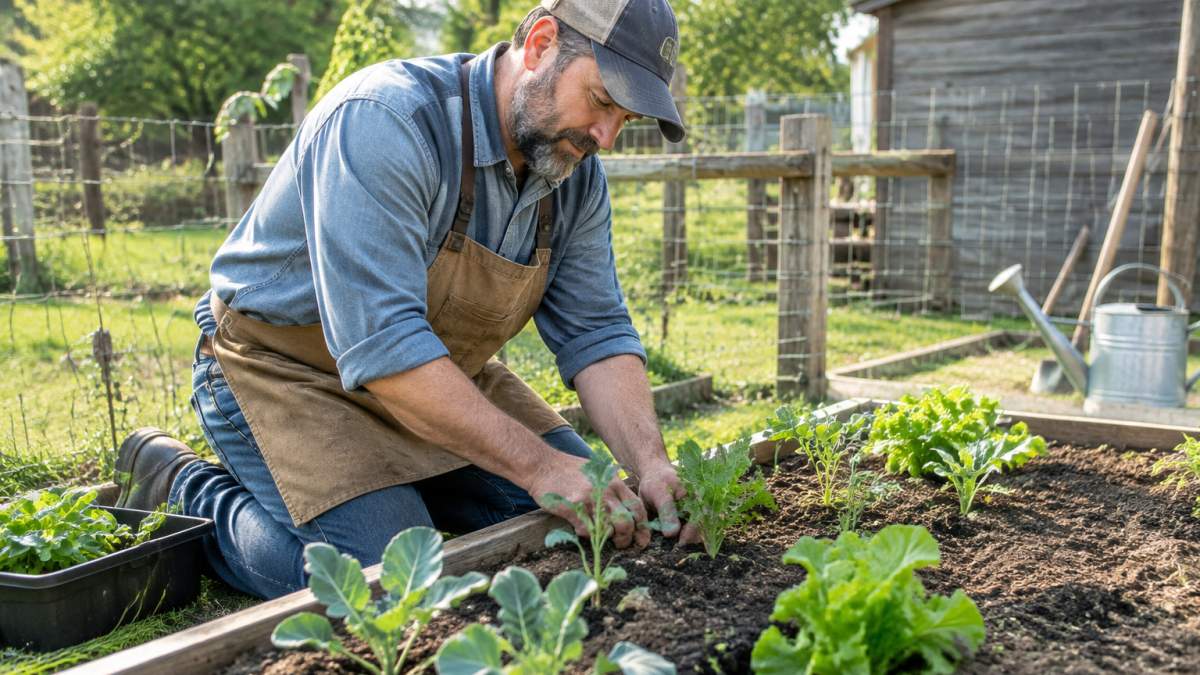
Choose crops your household will eat. Growing forty pounds of kale nobody likes wastes money and effort.
Follow these steps:
- Pick a sunny spot with easy access to water.
- Test your soil, or at least check drainage by digging a hole and filling it with water.
- Add compost to improve the soil.
- Plant seeds or seedlings at the spacing shown on the seed packet.
- Water deeply and less often, rather than a little every day.
- Harvest often to keep plants producing.
Save seeds from your best open-pollinated plants (seeds project). Saving seed cuts costs each year and builds gardening skills.
Watch out: planting too many crops in the first season leads to weeds, pests, and wasted produce.
Checklist for Starting a Homestead: A Phased First-Year Plan
Breaking the year into phases keeps you from trying to do everything in one weekend.
Phase 1: Months 1 to 2 (Plan and Prepare)
- Complete your land, time, and money inventory
- Choose your top goal
- Set up your budget sheet
- Check local rules for gardens and animals
Phase 2: Months 3 to 4 (Start Small)
- Build or set up one garden bed or container group
- Buy or collect soil and compost
- Plant your first crops
- Start a simple compost pile
Phase 3: Months 5 to 8 (Grow and Learn)
- Harvest and track yields
- Cook from scratch at least three times a week
- Start one food preservation project, such as freezing or pickling
- Note what worked and what failed
Phase 4: Months 9 to 12 (Review and Expand)
- Review your budget and total costs
- Compare food savings to your spending
- Plan next year's garden using saved seeds
- Decide whether to add one new project
This phased approach spreads costs out and shows you what is paying off.
Homesteading Without Owning Land and Other Low-Cost Options
You do not need to own land to live a homesteading lifestyle. Many people practice it on rentals, shared properties, and community spaces.
Here are practical options:
- Container gardening on a porch, balcony, or patio
- Community gardens, which often charge small yearly fees
- Sharing land with a friend or family member who has space, in exchange for produce or help
- Joining a community supported agriculture (CSA) program to buy local food while you build skills
Check your lease before you dig up a yard or build anything permanent. Many landlords allow containers but not raised beds, so ask first.
Homesteading without land is also a good way to test whether you enjoy the work before investing in property.
Your Next Step: Choosing the First Project to Start This Month
You have the inventory, goals, budget, and plan. Now pick one project and start it within 30 days.
Choose the project that matches your top priority and fits your budget and time. For most beginners, that means a small garden using containers or one raised bed.
Once that project works, add the next one. Slow, steady growth is how most successful homesteads begin.
Frequently Asked Questions
How can I get started with homesteading as a beginner?
Start small and in the order that matches your situation. Begin by inventorying what you already have: land or access to a yard, tools, skills, and monthly income. Pick one or two goals, such as growing a portion of your vegetables or preserving food, and tackle them before adding livestock or equipment. Track every expense in a simple spreadsheet so you can see where money goes. Most beginners do best with a first-year plan that adds one project per season, rather than trying to build everything at once.
How do I start a homestead with no money?
Lean on free and low-cost resources. Ask neighbors and local gardening groups for cuttings, seeds, and spare tools. Save seeds from produce you already buy, use containers and scrap lumber for beds, and compost kitchen scraps and yard waste instead of buying fertilizer. Check secondhand marketplaces and community swaps for equipment. Starting a homestead with no money mostly means trading time and effort for materials, so plan projects you can complete with what you have on hand.
How much does it cost to start a homestead?
Costs vary widely with land, climate, goals, and how much you buy new. A garden-focused start can be done with modest spending on seeds, soil, containers, and basic hand tools, while livestock, fencing, and barn work add substantial expenses. Pricing depends on quantity, timing, and where you buy, so request current quotes from suppliers and check prices directly with local retailers before planning your budget. Build the budget around your first-year priorities rather than a complete long-term setup.
Can you homestead without owning land?
Yes. Many people start with container gardening on a balcony or patio, rent a community garden plot, or grow herbs and vegetables in a shared yard with permission. Others keep small animals where local rules allow, or partner with a landowner who wants help in exchange for produce. Check local ordinances on gardening, composting, and any livestock before you begin, since zoning and HOA rules can limit what you are allowed to do.
